Showing posts with label Beer Reviews. Show all posts

Tuesday, February 7, 2017

Beer Review: Two Evil Pachamama Porter

In September, I reviewed Muy Malvada Porter, a collaboration brew between Lima's Cerveceria Barbarian, and the Two Roads and Evil Twin breweries. 

Muy Malvada was the test brew for a beer which was to be brewed and released in the US this Fall or Winter by Two Roads and Evil Twin.  That beer, which is available now, is Two Evil Pachamama Porter.

According to the blurb on the can, Pachamama Porter was created after a trek to Peru. In Andean cosmology the life-giving Earth is known as Pachamama, literally, "Mother Earth". The brewers felt that, "since our ingredients were provided by Mother Earth," they would name the beer after her. (Unfortunately, the trade name "Pachamama" was already trademarked in Peru, so the Peruvian version bore a different name.) and that it would be made "using local ingredients." Pachamama Porter is brewed with sweet potato, and Peruvian panca chiles and purple corn.

The Peruvian version was brewed using jora, the malted corn that is used to make traditional chicha corn brew, however, in Pachamama Porter, Two Roads and Evil Twin have substituted it with the purple corn used in making the non-alcoholic drink chicha morada. It might have been a flavor preference on the part of the brewers, but  I suspect it was due to the relatively easier and cheaper access to Peruvian purple corn over jora in the US.

Pachamama Porter has the deep brown color that is the hallmark of a porter, and plenty of body. There is a very pleasant earthiness, doubtlessly imparted by the panca chiles, and a very slight pepper note at the back end, and a light sweetness.  It is a complex and very tasty beer.

It clocks in at 6.5% abv, and although it lists no other specs on the can (nor on Two Roads' website), Muy Malvada came in at 20 IBUs, so it may be safe to surmise Pachamama has a similar amount.

I'm quite glad to have found it.


Monday, December 19, 2016

Review: Drake's 2016 Jolly Rodger "Translatlantic Winter Warmer"


In mid November, Drake's Brewing Co., in San Leandro (CA), released its 2016 edition of their Jolly Rodger Ale, and I was lucky enough to be sent a sample bottle.

For over two decades, Drake’s has held to their tradition of brewing a totally new beer every year for Jolly Rodger. This year’s version --which should be available through January-- is described as a "Transatlantic Winter Warmer."  It is made with the addition of dark candi sugar and a Belgian ale yeast, which account, I suppose for the "trans-Atlantic" part.

In the glass, the 2016 Jolly Rodger Ale is a lovely-looking beer. Dark copper-colored, almost red -thanks, to a great extent, I expect, to the candi sugar.  The head is not long-lasting, but the beer is nicely carbonated, even effervescent upon first tasting. 

It is malty, and spicy --not in a pumpkin pie-kind of way, but to my mind, more reminiscent of ginger bread or spice cake--- but not overpoweringly so.  The Belgian yest character is evident right up front, as is the candi sugar, but in the background there are notes of dried fruits --maybe of  dark cherries, maybe of prunes or raisins.

Both, in terms of flavor, and of alcohol (10% abv), it is indeed a warmer, but it is not a heavy beer.  With how cold it is tonight, I'm indeed glad I decided to pop open the bottle..


Further stats:  31 IBU | 10.0% ABV | 21.0° Plato O.G. | 4.5° Plato F.G.


Wednesday, September 28, 2016

Beer Review: Muy Malvada Peruvian Porter

Muy Malvada Peruvian Porter -whose name literally translates to "very evil one", but could be read as "very naughty one"- is a collaboration beer brewed by Lima's Cerveceria Barbarian, in conjuntion with Two Roads Brewing, out of Stratford, CT, and Evil Twin Brewing, with HQ in Brookly, NY.

Muy Malvada is brewed with jora, sweet potato, and aji panca. Jora is the germinated corn that is also used to make the Andes' traditional corn beer, chicha. Aji panca is a variety of chile pepper, specifically a variety of Capsicum baccatum, which is a staple of Peruvian cuisine. It has little to no heat, and mostly adds a bit of red tint and deep pepper flavour to dishes.

In Muy Malvada the pepper flavour is evident in the background, as a very, very tiny spiciness at the back end. Much more mild, in fact, that I've tasted in the US in beers brewed with ancho or chipotle chiles.

As porters go, Muy Malvada is actually quite nice, and coming in at 6.5% abv and 20 IBU, it is falls quite nicely within the definition of porter. Although it is more like an American porter than its British counterpart, the panca and perhaps the sweetness imparted by the sweet potato, do set it a bit apart.

I really liked this beer, and when I met one of the owners of Barbarian, Diego Rodriguez, I made it a point to ask about it and its genesis.

Diego explained that it came about as a joint project with the other two breweries, and the specialty ingredients were selected as a way of making the beer a Peruvian porter. I would say that they succeeded in giving it a local character. (In fact, when I read Stan Hieronymous' recently-published book, Brewing Local, this beer is one that kept coming to mind as a successful example of a beer with an evocation of place.)

Now, I grant you that this review comes a bit late, given that I was in Lima in July, but as Diego Rodriguez explained, the plan was that Evil Twin and Two Roads, and perhaps a rep from Barbarian, would rebrew the beer in the USA this Fall.

In the USA it is set to be marketed as Pachamama Porter (they had intended for that to be the name in Peru as well, but "Pachamama" was already registered to another brewery).

I have not seen any references to it on either Evil Twin's or Two Roads' websites or FB feeds, but if you live on the east coast or have access to their beers through a distributor, bar, or bottle shop, keep your eye out for this one. I think you won't be disappointed.


Thursday, June 2, 2016

"Estonya" Whiskey Barrel-Aged Imperial Porter

Recently, 10 Barrel Brewing has started a series of specialty, limited-release beers. These special beers will be hand-bottled and released roughly four to five times each year to select bottle shops in Oregon, Washington, California, Colorado, and Idaho, as well as through 10 Barrel’s pubs in Bend, Boise, and Portland.

The first off the line is Estonya, a Baltic-inspired imperial (11.9% ABV) porter crafted by 10 Barrel’s head Bend brewer, Tonya Cornett, who aged it in Blanton’s Bourbon barrels from West Virginia.

The brewery describes it as having "strong whiskey characteristics with notes of vanilla, milk chocolate, figs, and caramel," and intended to be cellared or drunk now, perhaps as a dessert beer or as a treat on its own.

Photo courtesy of 10 Barrel Brewing

Well, today I popped open a bottle of Estonya that was sent to me by 10 Barrel Brewing for review. (I've  got to point out that while the wax seal is a nice touch, aesthetically, it is a pain in the butt when it comes to uncapping the bottle!)

In the glass, Estonya is dark. Very dark, almost black. It does have a slight reddish undertone that sets apart from a stout in appearance.

It is a very satisfying draught, I must say. The nose is not heady, despite the high gravity.  I did not detect any outstanding alcoholic esters. What there is there is moderate and pleasant, and there is no alcoholic heat in the mouth (they do come in a bit as the beer warms.)

I certainly detected notes of figs and vanilla, but also a hint of dark cherries.  It is a bit sweet, in a way reminiscent of a milk stout.  It is smooth and round in the same way, as well, in terms of mouthfeel.

The brewery recommends Estonya with sweet dessert, but I think that as soon as I finish writing this, I'm going to cut a slice of Point Reyes Blue cheese to pair with it. I think it'll be a good match.

In sum, I like it! And I'm already thinking "where can I get another bottle?"

Saturday, April 30, 2016

Hard Frescos


Hard Frescos are a relatively new item, having been on the market for about a year.  They are the brain-child of Peter Stearns, from Santa Barbara, who worked for two years with experts at UC Davis to develop a way of making an alcoholic drink using pretty much only the ingredients that would go into Mexican aguas frescas, which were his inspiration.

Now, a "serious" beer drinker might well look at these and decide that they have no relation to beer, and that's a fair point. However, as they are brewed using fruit and then fermented using an ale or a lager yeast, depending on the batch, they have as much a relation to beer as a cider or a mead. In any case, the federal government has required the company to include some barley malt in all the recipes so they can class Hard Frescos as a "malt beverage."

I happened to met Stearns at the Hard Frescos booth at the recent Bay Area Craft Brew Festival, and he sent me home with some samples. Well, I've tried every one of what he gave me and I've got to say that I do like them.

The three flavors I sampled were "Citrico" -made with citrus-, "Tangy Tamarindo" -made with tamarind-, and "Juicy Jamaica" -made with hibiscus blossoms. Of the three (there is also a fourth flavor: "Cola Buena"), I by far preferred the "Citrico" (so glad he gave two of those!), followed by the "Tangy Tamarindo."  

Served cold, Hard Frescos are easy to drink and refreshing. All of the flavors contain around 5% ABV, but what comes through most brightly is the fruit used in their preparation. The adjectives that most come to mind are fun and friendly

As they are a bit removed from the Belgian and farmhouse ales that I tend to prefer, I'm not sure that I'd stock them in my fridge --although they do hold out the promise of some interesting cocktails-- but I'd happily order a Hard Frescos at a restaurant or taco truck.  

They would certainly hit the spot as a "grown up" alternative any time one might reach for a Jarritos or a Peñafiel.

Saturday, January 23, 2016

Anchor's new Go West! IPA

When I toured Anchor's brewery in mid-November, head brewer Mark Carpenter offered us guests samples of a still-experimental IPA that the brewery was considering as an addition to its line-up of beers.  Well, those experiments have borne fruit and this month Anchor released its newest beer: Go West! IPA.


Go West! Launch Party

To mark the release of Go West! Anchor is holding a series of public release events at different venues throughout SF Beer Week. However, I was able to attend a special invitation-only launch party at the brewery itself on Thursday evening.


There I joined other guests in tasting Go West! as well as many of Anchor's other beers, all flowing freely from the tap room and from draught stations set up throughout the brewhouse, along with hors d'oeuvres including cured meat and cheese pairings, beer ice cream, beer floats, and more. (I highly recommend making your float with Anchor Barrel Ale, by the way.)


The Beer

Ok. So, on to the beer itself...

Anchor's own literature describes Go West! IPA as
"Made with 2-row pale barley malt and dry-hopped with a unique blend of American hops. Its mouthwateringly complex aromas of citrus, pine, and the tropics; spiky bitterness; gleaming golden color; and clean finish unite to create this singular 24-karat IPA."

I found it to be very enjoyable, and somewhat unique for an American IPA, and particularly for a West Coast IPA.  

Of couse, being an IPA, it is hop-forward in flavour, but bucking the trend out here, it is not a palate-numbing hop bomb, and it doesn't include Cascade hops. Instead, fruit and citrus flavours do stand out, but the beer is well balanced, and finishes really clean.

The fact that Go West! IPA is so balanced and not overly hoppy is a testament to the skill of Anchor's brewers, particularly since --I was told-- it includes the addition of 3 types of hops in the kettle and 4 more during fermentation.  I can't remember them all, but I do distinctly recall that Citra hops were one of the ones that went into dry-hopping.

Like I said, I really enjoyed Go West! IPA. I think that Anchor hit it out of the ball park with this beer!


As for the stats: Go West! clocks in at 6.7% ABV and 75 IBUs. I didn't inquire about it's SRM.

Saturday, November 14, 2015

Anchor Christmas Ale and Spirit Release


On November 7th I had the opportunity to partake of a VIP brewery tour of Anchor Brewing and Anchor Distilling in San Francisco.  The event was Anchor's 2015 Media Brewery Tour to mark this year's release of their Winter Wheat Ale and the 2015 Merry Christmas and Happy New Year ale, from the brewery, and the 2015 Christmas Spirit from the distillery.

The current brewery is located on Potrero Hill in San Francisco, although there are plans to move to a new, larger location in the near future. I had never been to the Anchor brewery, even though I had long wanted to visit it. Tours book up well in advance, so it has seemed hard to find a time when I could go on one, even though I now live within moderately easy driving distance, so I was pretty happy to receive the invitation to this tour.

Upon arriving, and going up the stairs, one first enters the brewery's well-appointed tap room. 

 Aside from the handsome bar, the room is lined with cabinets and wall displays filled with curiosities and antiques relating to Anchor Brewing, steam beer, and brewing in San Francisco generally.

Behind the bar, lining the edge of the cooler, is a display of Anchor bottles, old and recent.  Among the curiosities displayed there are two bottles of Anchor Steam with the labels upside down.

Mark Carpenter, who is the head brewer at Anchor, and who conducted the tour for us, shared that those were issued after the 1989 earthquake.

When the earthquake struck and the power went out, the beer was still in the kettles.  Mark and some colleagues, along with neighbors, stayed on at the brewery until the power came back on and they were able to transfer the wort to the fermenters.  Because the wort had sat in the kettles longer than the usual, the finished beer tasted different than the normal batches.  Rather than throw it out, then-owner Fritz Maytag decided to bottle and release it, but with a difference.

Passing through the tap room, we were invited into the brewery proper.


The guest list consisted of about two dozen bloggers and social-media types -hence my invite- who got to taste the new releases, enjoy hors d'oeuvres (including some yummy "lobster corn dogs") and learn about the brewery.


To showcase the 2015 Christmas Spirit, they had a mixologist on hand preparing a couple of cocktails using the spirit, and other liquors and liqueurs imported by Anchor's distilling arm. (Recipes at the end of this post.)

The Christmas Spirit, of which this year's is the third batch released commercially, is made each year by distilling the previous year's Christmas ale and, like on the Christmas beer, the tree on the label is different each year. It is a clear, unaged whisky, which comes in at 45% ABV. 

I asked the barman for a bit of it neat, and my curiosity was well-rewarded.  Oftentimes one is led to expect unaged spirits to be a bit harsh or to have an alcoholic "hotness", but this spirit puts that notion flatly to rest.  It is really quite smooth.  (Unfortunately, Anchor is not able to sell it on premises until new laws come into effect on Jan. 1st, so I was unable to come away with a bottle.)


After a bit, Mark started the tour by inviting us back into the taproom to tell us a bit about Anchor's history, and about the new beers.


He explained that while the Winter Wheat is produced employing a steady recipe, arrived at after some tweaking and experimentation, the Merry Christmas, Happy New Year ("Our Special Ale") is different each year. As this is the 41st iteration of that beer, Anchor has produced forty-one different "Special Ales" in that time, and for 41 years fans have been kept guessing as to what has gone into each, as the brewery keeps the formulation a well-guarded secret.


Left: Christmas Ale; Right: Winter Wheat Ale


It is widely assumed that the recipe generally contains spices, and this year's very tasty Special Ale has a hint of cloves, which could be the result of cloves being part of the mix, or from the yeast --although Mark said they use the same house yeast strain in the Special Ale as they do in Anchor Steam and their other ales.  In any case, Mark was coyly evasive as to whether cloves were present or not, however he did let out that the two spices that certainly do not go into the recipe are allspice and frankincense. 

Then, after sampling the brews, he led us on a tour of the facility, from the brewhouse on the third floor to the cold room and fermentation tanks in the basement, to the bottling and canning lines, shipping warehouse on the ground floor.


The lovely all-copper brewhouse


In the hop storage room
Anchor uses traditional open fermentaters for their primary fermentation.

Secondary fermentation tanks in the basement

The last stop on the tour was the distillery .


Anchor Distilling dates back to 1993, with Fritz Maytag's foray into spirits production with Old Potrero, an old-style pot-distilled rye whiskey.  At the time, it was one of the few rye whiskeys being produced in the US and the only legally-produced commercial whiskey produced in a pot still (all others were produced in column or in continuous distillation stills).


Old Potrero was followed soon after by Junipero Gin, and Genevieve Genever-style Gin. Today the distillery's offerings also includes two other variants of Old Potrero --an "18th Century" whiskey and an aged 16-year old one-- as well as an Old Tom gin, and Hophead hop-infused vodka.


Afteward we repaired to the brewhouse and taproom for some more drinks, where I was pleased of the chance to taste a still-experimental IPA that Anchor was trying out for addition to it's beer lineup.

All in all, I had a really good time and it was great to meet Mark and visit what is an icon in the craft beer scene.

Now, all I've got to do is find somewhere to get a bottle of the Christmas Spirit ....


_______________________________


Wednesday, August 5, 2015

Cerveza Hops (Lima - Peru)


The first craft brewery I visited on this trip was actually Hops in Lima's Pueblo Libre district, just down the street from the Queirolo tavern and kitty-corner across the plaza from the Archaeology and Anthropology Museum.


Hops does not seem to emphasize its beer production side very much, but rather seems to have put its focus on its role as a multi-story discotheque and event space, with a brew-on-premises pub and restaurant included.   For example, the fermentation tanks are visible to the public, but are located on a second story and in a part of the building that, while open, is not utilized during the day.

That is too bad, because one of the challenges that craft brewers have in Peru is overcoming Peruvians' unfamiliarity with brewing and beer styles other than Pilsner-style lagers and dark lagers, and educating the public on them can only help the craft beer market grow.  And I think people would be interested, and that in itself would draw more customers.

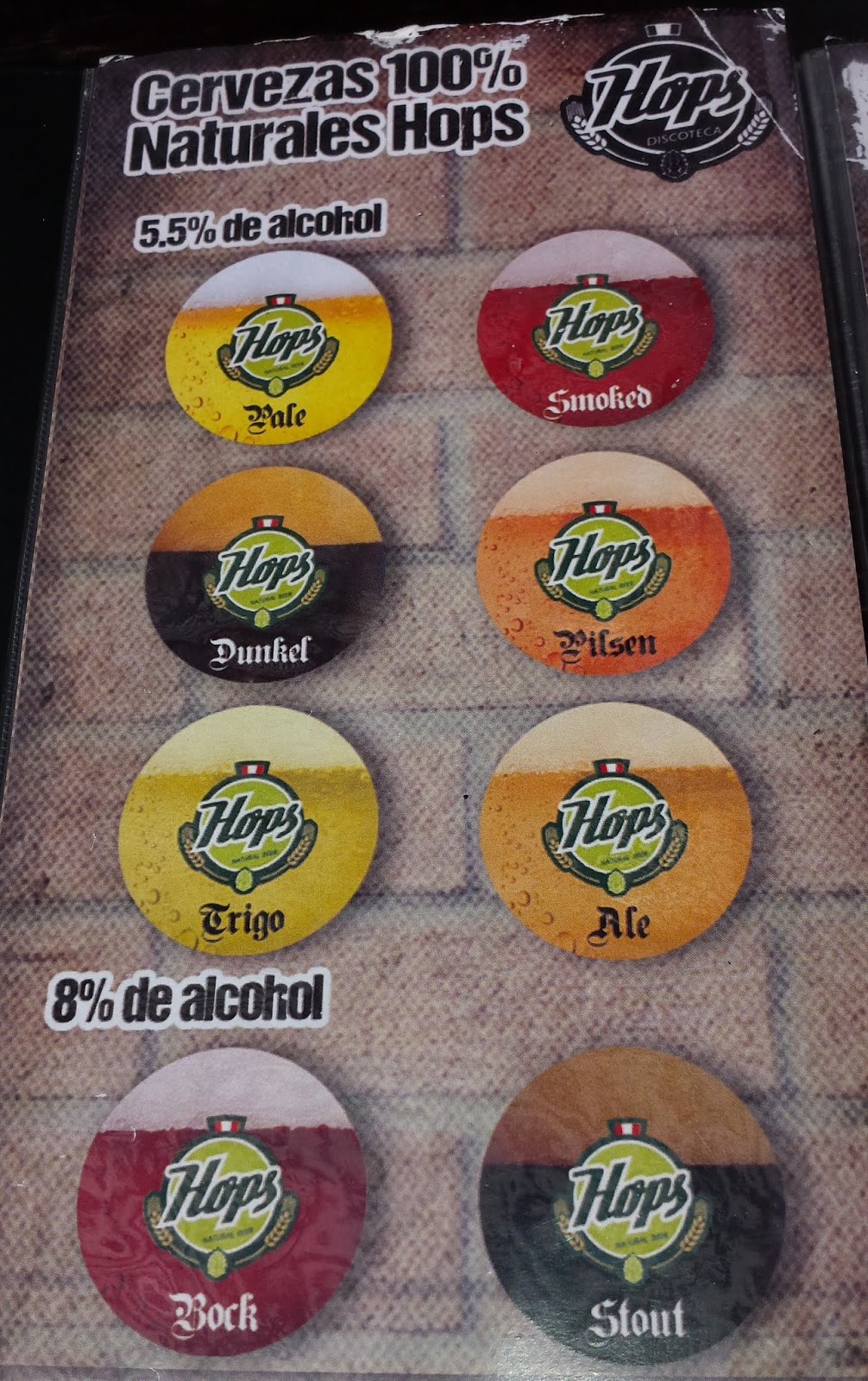
The house beer menu

In any case, Hops has a decent selection of house beers brewed right on the premises, and even claims to have Peru's first and, so far, only beer made with  smoked malt.

Unfortunately, they were out of the Smoked beer and of both the Bock and the Stout, on the day I visited, but I did get to try some of the others.
The beers were nice.  Not as good as what we'd expect from a quality craft brewery here in the US, but definitely drinkable and enjoyable.  We must remember that the craft brewing scene in Peru is very new and ingredients --particularly hop varieties and specialty yeast strains-- are hard to come by.  Given those constraints Hops deserves to be commended for being one of the pioneers of craft brewing in Lima, having been established nine years ago.


After enjoying the Pale in the afternoon, with lunch, I returned in the evening to sample more accompanied by my dad.

I liked all the beers I tried, but I particularly liked the Dunkel. It could easily have been a lager with some color added, but instead it had more body and a slight roasted character which I liked and, actually, was looking for (I had really wanted to try the stout).


Pale ale
Dunkel
Wheat beer


Hops
Av. General Manuel Vivanco 785
Pueblo Libre, Lima
Peru
www.hops.com.pe

Wednesday, July 22, 2015

Craft Beer Booth at the Lima Book Fair

I had a hard time at the Lima  book fair yesterday, I must say.

The fair is set up under a tent erected over the central part of park, covering a fountain and a number of steps.  The floor is thus of plywood sheets over a frame, and covered with carpeting, all of which makes in a bit uneven in many spots.  With my aching and sensitive knee, it made walking difficult, and even a bit perilous.   It was also very hot under the tent, and my off-gait was causing me to expend extra effort as it was.


Fortunately, there is a craft beer stand in the food court, set up and run by a small distributor representing four small breweries - three from Lima and one from Cusco.


I chose two beers to try.

First, I opted for the Ayrampo Roja from the Sacred Valley Brewery, whose beers I had never tried before.


The Ayrampo Roja (6% ABV, 35 IBU) is a red beer (hence the roja) coloured with caramel malt and the fruit of the ayrampo cactus, which is native to the Peruvian Andes and has long been used to color foods in the highlands.  The beer was good, and there was no ayrampo flavour (it can taste a bit like red beets).

Next, I went for one from the Cumbres brewery.  I have tried one other of Cumbres' beers, their Quinoa Kolsch, so I was anxioux to try another of their offerings.


I opted for the Maracumanto (6.2 % ABV).   Maracumanto is a Belgian Pale Ale, fermented with maracuuyá and aguaymanto  fruit.   I half expected it to be sour, owing to the presence of the maracuyá, but it was not sour at all.  It was actually very refreshing, and relatively low in fruit notes in the mouth, even though they came through in the nose.

Needless to say, I then felt quite refreshed!

Saturday, February 15, 2014

Third Street Ale Works (Santa Rosa)


Today Liz and I headed to Petaluma to pick a half of a pastured pig carcass that we had ordered.  Before heading to the meat processor, we he drove a bit further north, to Santa Rosa, and had lunch at the Third Street Aleworks.

I started off with a pint of their dry Irish stout.  The brewery took home a gold medal with this recipe at last years Great American Brew Fest in Colorado.

It was very nice.  Smooth, dry, with a toasty, coffee note, but without being a big or heavy beer.  

I followed it with a pint of their red IPA, which garnered them a bronze at GABF.  Liz had a tasting portion of their Annadel Pale Ale, served straight from the conditioning cask.  It was smooth, malty, but not being force carbonated, came off a bit flat, specially having been kept and served at room temperature.


Saturday, December 21, 2013

Sour beers

My newest taste obsession