Thursday, March 3, 2016

The Session #109: Porter

http://brookstonbeerbulletin.com/the-sessions/Porter. It's one of those beers that has come and gone in my repertoire and taste preferences, but although I seem to have settled pretty clearly on saisons, "farmhouse" ales, and sours, porter holds some strong and dear associations, still.

Back to the early 1990s when --after failing at making chicha in our Santa Cruz apartment-- it ocurred to me that I should actually look into making my own beer,  I ordered Charlie Papazian's The Complete Joy of Homebrewing via university interlibrary loan, and photocopied most of it before I had to return it (I have since then made up for that by buying a brand-new copy). 

It wasn't until I moved to the Bay Area that I had access to homebrewing supplies, but in the intervening year, I pored over those pages, trying to imagine what all those kinds of beer, many of which I had never heard of, might taste like.    The craft beer explosion was only just starting, so there  there really wasn't much beer variety around, and even now-commonplace-seeming beers such as Anchor Steam or Redhook ESB felt like serendipitous and exotic finds. I didn't really have a notion of hops and their role, but I understood color, mouthfeel, and flavour, and I associated  more of those with robust darkness, much as coffee is more flavorful and robust than tea.
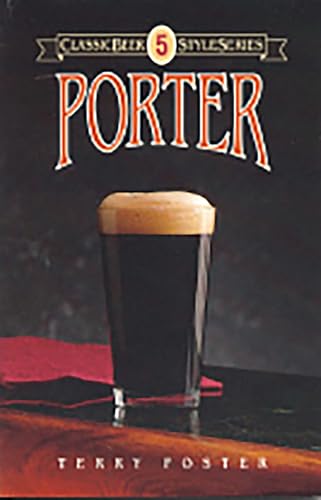
Add to that a sense that porter, an old style of beer, represented as it "used to be" and, perhaps, as it "ought to be", and it is hardly surprising that it came to hold an almost romantic allure.  That was abetted by recipes like "Goat Scrotum Ale" and "Sparrow Hawk Porter" in The Complete Joy .... Reading Terry Foster's Porter also served to foster the feeling that porter was a beer style redolent with history and tradition.

What was the first porter I tried? I'm not fully certain of that, but the first I do distinctly remember --because I chose it because it was a porter-- was Samuel Smith's Tadcaster (or "Taddy") Porter. I remember that I really liked it.  For a while, it became a steady feature of my beer diet, but porter also proved the "gateway drug" to "bigger beers", and as I fell prey to those heady days of the craft beer revolution, and my own homebrewing revolution, in which the focus was one "more!", and "most!", I moved away porter, following a trail that led to oatmeal stouts, imperial stouts, IPAs, and barley wines.

Today, even though porter has sort of become a somewhat pedestrian style, almost an afterthought, it seems, in a sea of IPAs, part of any brewery's basic repertoire, porter does hold its own in that any brewery or brewpub worth its salt has to have at least one porter on its menu.

And, that same allure that porter brought to the US beer scene twenty years ago is now being repeated in the nascent South American craft beer scene.


Cerveceria Barbarian and Cerveza Nuevo Mundo in Lima, and Sierra Andina in Huaraz, for example, are producing very nice porters in a land -Peru- which, although it once had had porters and stouts, had not seen anything like them being produced locally in a long, long time.

Part of the reason I was eager to participate in this Session's topic, is that in experiencing and tasting their rediscovery of porter, I have rediscovered it for myself!

(I had tried to get a Sam Smith's Taddy Porter to have while I wrote this, but sadly where it was once ubiquitous, it is now not to be found, but I am enjoying a Sierra Nevada Porter.)


_____________________

Related links:

Saturday, February 13, 2016

Anheuser-Busch Brewery - Fairfield


On Super Bowl weekend, taking advantage of the good weather and the fact that famous Clydesdales would be there, Liz and I headed to the Budweiser brewery in Fairfield.

Opened in 1976, the Fairfield brewery is one of two Anheuser-Busch breweries in California, and as big as it is -16 roofed acres-, it is the smaller of the two, and the second smallest among AB's twelve breweries in the US.

Since AB was purchased by Inbev, the AB production line of beers has expanded, and the Fairfield plant now produces Budweiser, Bud Ice, Bud Light, Busch, Busch Ice, Busch Light, Natural Light, Hurricane, King Cobra, Natural Ice, Rolling Rock, and Shock Top.  It supplies the US West Coast (other than Southern California), plus Alaska, Hawaii, and South America.


The brewery offers three levels of tours, all of which they charge for; the basic brewery tour being $5 while the "Flights of Fairfield" tasting tour is $10, and the 2-hour "Beer Master" tour $30.

The $5 tour lasts an hour, and starts with getting everyone a beer and watching a video on beer production at Anheuser-Busch

The video itself is not that interesting and is sparing on some details -for example, it does not really explain the role of hops in beer- but the brewhouse shown on it is as close as many will get one on this tour.  Probably because of the sheer size of the plant, and its location clear at the other end of it, the Fairfield brewhouse is not included in the basic tour, but is part of the longer "Beer Master" tour.

The explanantion by the guide was a bit more interesting, and I learned a few things from it. For example, that Anheuser-Busch was a pioneer in bottling beer in the US, in pasteurizing beer, and in transporting beer in refrigerated train cars --which they did by loading the front of the car with blocks of ice which cooled the air, while the train's forward movement circulated it around the cases of beer-- which enabled Budweised to become the first beer with nationwide distribution.

The guide did also mention that the name "Budweiser" was just "an invention" made up by Adolphus Busch, and had no meaning but was just meant to "sound German."  No mention was made --even by me!-- of ol' Adolphus' inspiration from his trip to Bohemia, and the subsequent name dispute with the Budvar brewery in the Czech town of Budweis.

As the Fairfield brewery was directed a while back to concentrate on canning and kegging, the tour then proceeds through a fairly large empty space in the production area, which once held the bottling line.

Me with the fermentation tanks.  Each horizontal tank is 12' tall by 72' long.
It then proceeds to the cool room and the fermentation area, where the much-vaunted beechwood aging process is explained.  You even get to take home a souvenir piece of beechwood that's been used in the fermentation process!

At tour's end, one is returned to the visitors' hall and led to the tap room at the back of the gift shop area, where one can redeem one's ticket for 6-oz pour of beer.  Naturally, one may purchase other beers --full-sized of course!--, select from a menu of flights, or design one's own flight, of Anheuser-Busch/Inbev beers.

In the taproom

A made-in-Fairfield flight. From L: Bud Light, Budweiser, Rolling Rock, and Shocktop Belgian White.


Anheuser-Busch Brewery
3101 Busch Drive,
Fairfield, CA 94534


(707) 429-7595
www.budweisertours.com/locations/fairfield-california.html

Saturday, January 23, 2016

Anchor's new Go West! IPA

When I toured Anchor's brewery in mid-November, head brewer Mark Carpenter offered us guests samples of a still-experimental IPA that the brewery was considering as an addition to its line-up of beers.  Well, those experiments have borne fruit and this month Anchor released its newest beer: Go West! IPA.


Go West! Launch Party

To mark the release of Go West! Anchor is holding a series of public release events at different venues throughout SF Beer Week. However, I was able to attend a special invitation-only launch party at the brewery itself on Thursday evening.


There I joined other guests in tasting Go West! as well as many of Anchor's other beers, all flowing freely from the tap room and from draught stations set up throughout the brewhouse, along with hors d'oeuvres including cured meat and cheese pairings, beer ice cream, beer floats, and more. (I highly recommend making your float with Anchor Barrel Ale, by the way.)


The Beer

Ok. So, on to the beer itself...

Anchor's own literature describes Go West! IPA as
"Made with 2-row pale barley malt and dry-hopped with a unique blend of American hops. Its mouthwateringly complex aromas of citrus, pine, and the tropics; spiky bitterness; gleaming golden color; and clean finish unite to create this singular 24-karat IPA."

I found it to be very enjoyable, and somewhat unique for an American IPA, and particularly for a West Coast IPA.  

Of couse, being an IPA, it is hop-forward in flavour, but bucking the trend out here, it is not a palate-numbing hop bomb, and it doesn't include Cascade hops. Instead, fruit and citrus flavours do stand out, but the beer is well balanced, and finishes really clean.

The fact that Go West! IPA is so balanced and not overly hoppy is a testament to the skill of Anchor's brewers, particularly since --I was told-- it includes the addition of 3 types of hops in the kettle and 4 more during fermentation.  I can't remember them all, but I do distinctly recall that Citra hops were one of the ones that went into dry-hopping.

Like I said, I really enjoyed Go West! IPA. I think that Anchor hit it out of the ball park with this beer!


As for the stats: Go West! clocks in at 6.7% ABV and 75 IBUs. I didn't inquire about it's SRM.

Wednesday, January 20, 2016

1 step forward, 2 steps back

In a month's time, Contra Costa County has gained a brewery, but lost another plus a tap room.

Ale Industries got its start in the county, with its original brewery having been located in wharehouse space next to the MoreBeer! showroom in Concord, where some of guys also worked.  After a few good years there, they felt the need to expand their facility, and to brew closer to the owners' homes in Oakland.  The story is that in 2013 they moved the brewery piece by piece, in a pickup truck, to the new Oakland facility, which opened in 2014.

However, Ale industries did not abandon Contra Costa, and opened their Concord tap room, The Pig & The Pickle, even as they were opening the brewery in Oakland.


Unfortunately, on December 7th Ale Industries announced on the The Pig & The Pickle's FaceBook page that, in order to "restructure and reinvent our retail presence" it was "temporarily" closing The Pig & The Pickle, inviting everyone to instead visit their brewery tap room in Oakland.

Then, on January 12th, Pyramid announced on FaceBook and on its webpage that the Pyramid Alehouse in Walnut Creek was closed. Following the closure of the Berkeley alehouse, this move leaves Pyramid with no taprooms or brewpubs in California.

On the plus side, the county has had the opportunity to welcome a new face to the beer scene: Concord's Epidemic Ales.  

Epidemic held the grand opening of their brewery and tap room at 150 Mason Cir. on Jan. 2nd.   They managed to get it all set up in time for SF Beer Week, which they are participating in.

I hope to get to their facility soon to sample some of their brews.


 Correction:  I stated above that Pyramid has no taprooms left in California. They do in fact have at least one small one, in Terminal 2 of the Oakland International Airport. (5/28/16)


Wednesday, January 13, 2016

Barrelista


With twenty-eight bottled beers and another three or four on tap, Barrelista Coffee House is working out to be one of the better beer spots in downtown Martinez!


Barrelista Coffee House
736 Main Street
Martinez, CA